
页面加载中,请稍候
来源:开源Linux发布时间:2022-11-291134浏览
询问 AI
大家都知道 k8s 容量不够的时候,都是添加节点来解决问题。这几天有小伙伴在升级 k8s 容量的时候碰到一个问题,他将集群中某一个 node 节点的 CPU 做了升级,然后重启了这个 node 节点导致 kubelet 无法启动,然后大量 pod 被驱逐,报警电话响个不停。为了紧急恢复业务,果断参加故障恢复。
现象获取在知道事件背景后,我登上了那个已经重启完毕的 node 节点,开始了一系列的网络测试,确认 node 这个宿主机到 Apiserver 和 Loadbalancer 的 ip 和 port 都是通的。随后赶紧看了下 kubelet 的日志,果不其然,一行日志让我看到问题点:
E112123:43:52.64455223453policy_static.go:158]"Staticpolicyinvalidstate,pleasedrainnodeandremovepolicystatefile"err="currentsetofavailableCPUs\"0-7\"doesn'tmatchwithCPUsinstate\"0-3\""
E112123:43:52.64456923453cpu_manager.go:230]"Policystarterror"err="currentsetofavailableCPUs\"0-7\"doesn'tmatchwithCPUsinstate\"0-3\""
E112123:43:52.64458723453kubelet.go:1431]"FailedtostartContainerManager"err="startcpumanagererror:currentsetofavailableCPUs\"0-7\"doesn'tmatchwithCPUsinstate\"0-3\""
说到这里,很多小伙伴会说:“就这??”。
真的就这。是因为啥呢?
是因为 kubelet 启动参数里面有一个参数很重要:--cpu-manager-policy。表示 kubelet 在使用宿主机的 cpu 是什么逻辑策略。如果你设定为 static ,那么就会在参数 --root-dir 指定的目录下生成一个 cpu_manager_state 这样一个绑定文件。
cpu_manager_state 内容大致长得如下:
{"policyName":"static","defaultCpuSet":"0-7","checksum":14413152}
当你升级这个 k8s node 节点的 CPU 配置,并且使用了 static cpu 管理模式,那么 kubelet 会读取 cpu_manager_state 文件,然后跟现有的宿主运行的资源做对比,如果不一致,kubelet 就不会启动了。
原理分析既然我们看到了具体现象和故障位置,不妨借着这个小问题我们一起开温馨下 k8s 的 cpu 管理规范。
官方文档如下:
https://kubernetes.io/zh-cn/docs/tasks/administer-cluster/cpu-management-policies/
当然我还想多少说点别的,关于 CPU Manager 整个架构,让小伙伴们有一个整体理解,能更加深入理解官方的 cpu 管理策略到底是做了些什么动作。
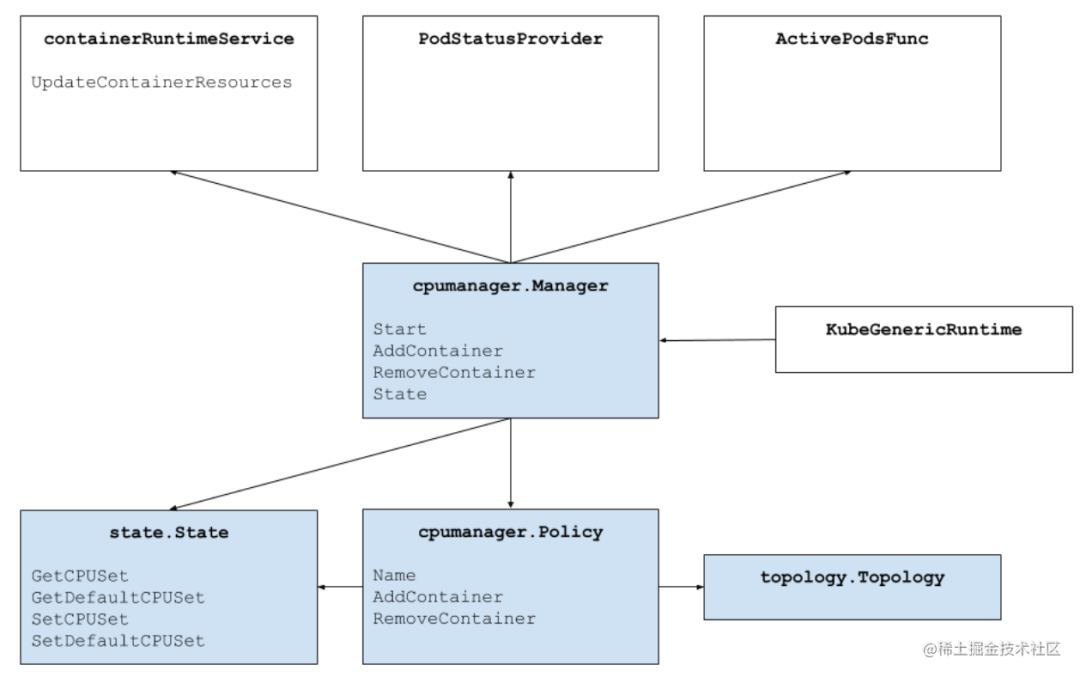
CPU Manager 为满足条件的 Container 分配指定的 CPUs 时,会尽数按 CPU Topology 来分配,也就是参考 CPU Affinity,按如下的优先顺序进行 CPUs 选择:(Logic CPUs 就是 Hyperthreads)
Container 托余请求的 Logic CPUs 则从按以下规则排列好的 Logic CPUs 列表中选择:
参考代码:pkg/kubelet/cm/cpumanager/cpu_assignment.go
functakeByTopology(topo*topology.CPUTopology,availableCPUscpuset.CPUSet,numCPUsint)(cpuset.CPUSet,error){
acc:=newCPUAccumulator(topo,availableCPUs,numCPUs)
ifacc.isSatisfied(){
returnacc.result,nil
}
ifacc.isFailed(){
returncpuset.NewCPUSet(),fmt.Errorf("notenoughcpusavailabletosatisfyrequest")
}

//Algorithm:topology-awarebest-fit
//1.Acquirewholesockets,ifavailableandthecontainerrequiresat
//leastasocket's-worthofCPUs.
for_,s:=rangeacc.freeSockets(){
ifacc.needs(acc.topo.CPUsPerSocket()){
glog.V(4).Infof("[cpumanager]takeByTopology:claimingsocket[%d]",s)
acc.take(acc.details.CPUsInSocket(s))
ifacc.isSatisfied(){
returnacc.result,nil
}
}
}

//2.Acquirewholecores,ifavailableandthecontainerrequiresatleast
//acore's-worthofCPUs.
for_,c:=rangeacc.freeCores(){
ifacc.needs(acc.topo.CPUsPerCore()){
glog.V(4).Infof("[cpumanager]takeByTopology:claimingcore[%d]",c)
acc.take(acc.details.CPUsInCore(c))
ifacc.isSatisfied(){
returnacc.result,nil
}
}
}

//3.Acquiresinglethreads,preferringtofillpartially-allocatedcores
//onthesamesocketsasthewholecoreswehavealreadytakeninthis
//allocation.
for_,c:=rangeacc.freeCPUs(){
glog.V(4).Infof("[cpumanager]takeByTopology:claimingCPU[%d]",c)
ifacc.needs(1){
acc.take(cpuset.NewCPUSet(c))
}
ifacc.isSatisfied(){
returnacc.result,nil
}
}

returncpuset.NewCPUSet(),fmt.Errorf("failedtoallocatecpus")
}
参考代码:vendor/github.com/google/cadvisor/info/v1/machine.go
typeMachineInfostruct{
//Thenumberofcoresinthismachine.
NumCoresint`json:"num_cores"`

...

//MachineTopology
//Describescpu/memorylayoutandhierarchy.
Topology[]Node`json:"topology"`

...
}

typeNodestruct{
Idint`json:"node_id"`
//Per-nodememory
Memoryuint64`json:"memory"`
Cores[]Core`json:"cores"`
Caches[]Cache`json:"caches"`
}
cAdvisor 通过 GetTopology 完成 cpu 拓普信息生成,主要是读取宿主机上 /proc/cpuinfo 中信息来渲染 CPU Topology,通过读取 /sys/devices/system/cpu/cpu 来获得 cpu cache 信息。
参考代码:vendor/github.com/google/cadvisor/info/v1/machine.go
funcGetTopology(sysFssysfs.SysFs,cpuinfostring)([]info.Node,int,error){
nodes:=[]info.Node{}

...
returnnodes,numCores,nil
}
对于前面提到的 static policy 情况下 Container 如何创建呢?kubelet 会为其选择约定的 cpu affinity 来为其选择最佳的 CPU Set。
Container 的创建时 CPU Manager 工作流程大致下:
参考代码:pkg/kubelet/cm/cpumanager/cpu_manager.go
func(m*manager)AddContainer(pod*v1.Pod,container*v1.Container,containerIDstring){
m.Lock()
deferm.Unlock()
ifcset,exists:=m.state.GetCPUSet(string(pod.UID),container.Name);exists{
m.lastUpdateState.SetCPUSet(string(pod.UID),container.Name,cset)
}
m.containerMap.Add(string(pod.UID),container.Name,containerID)
}
参考代码:pkg/kubelet/cm/cpumanager/policy_static.go
funcNewStaticPolicy(topology*topology.CPUTopology,numReservedCPUsint,reservedCPUscpuset.CPUSet,affinitytopologymanager.Store,cpuPolicyOptionsmap[string]string)(Policy,error){
opts,err:=NewStaticPolicyOptions(cpuPolicyOptions)
iferr!=nil{
returnnil,err
}

klog.InfoS("Staticpolicycreatedwithconfiguration","options",opts)

policy:=staticPolicy{
topology:topology,
affinity:affinity,
cpusToReuse:make(map[string]cpuset.CPUSet),
options:opts,
}

allCPUs:=topology.CPUDetails.CPUs()
varreservedcpuset.CPUSet
ifreservedCPUs.Size()>0{
reserved=reservedCPUs
}else{
//takeByTopologyallocatesCPUsassociatedwithlow-numberedcoresfrom
//allCPUs.
//
//Forexample:Givenasystemwith8CPUsavailableandHTenabled,
//ifnumReservedCPUs=2,thenreserved={0,4}
reserved,_=policy.takeByTopology(allCPUs,numReservedCPUs)
}

ifreserved.Size()!=numReservedCPUs{
err:=fmt.Errorf("[cpumanager]unabletoreservetherequiredamountofCPUs(sizeof%sdidnotequal%d)",reserved,numReservedCPUs)
returnnil,err
}

klog.InfoS("ReservedCPUsnotavailableforexclusiveassignment","reservedSize",reserved.Size(),"reserved",reserved)
policy.reserved=reserved

returnpolicy,nil
}

func(p*staticPolicy)Allocate(sstate.State,pod*v1.Pod,container*v1.Container)error{
ifnumCPUs:=p.guaranteedCPUs(pod,container);numCPUs!=0{
klog.InfoS("Staticpolicy:Allocate","pod",klog.KObj(pod),"containerName",container.Name)
//containerbelongsinanexclusivelyallocatedpool

ifp.options.FullPhysicalCPUsOnly((numCPUs%p.topology.CPUsPerCore())!=0){
//SinceCPUManagerhasbeenenabledrequestingstrictSMTalignment,itmeansaguaranteedpodcanonlybeadmitted
//iftheCPUrequestedisamultipleofthenumberofvirtualcpusperphysicalcores.
//IncaseCPUrequestisnotamultipleofthenumberofvirtualcpusperphysicalcoresthePodwillbeput
//inFailedstate,withSMTAlignmentErrorasreason.Sincetheallocationhappensintermsofphysicalcores
//andtheschedulerisresponsibleforensuringthattheworkloadgoestoanodethathasenoughCPUs,
//thepodwouldbeplacedonanodewherethereareenoughphysicalcoresavailabletobeallocated.
//Justlikethebehaviourincaseofstaticpolicy,takeByTopologywilltrytofirstallocateCPUsfromthesamesocket
//andonlyincasetherequestcannotbesattisfiedonasinglesocket,CPUallocationisdoneforaworkloadtooccupyall
//CPUsonaphysicalcore.Allocationofindividualthreadswouldneverhavetooccur.
returnSMTAlignmentError{
RequestedCPUs:numCPUs,
CpusPerCore:p.topology.CPUsPerCore(),
}
}
ifcpuset,ok:=s.GetCPUSet(string(pod.UID),container.Name);ok{
p.updateCPUsToReuse(pod,container,cpuset)
klog.InfoS("Staticpolicy:containeralreadypresentinstate,skipping","pod",klog.KObj(pod),"containerName",container.Name)
returnnil
}

//CallTopologyManagertogetthealignedsocketaffinityacrossallhintproviders.
hint:=p.affinity.GetAffinity(string(pod.UID),container.Name)
klog.InfoS("TopologyAffinity","pod",klog.KObj(pod),"containerName",container.Name,"affinity",hint)

//AllocateCPUsaccordingtotheNUMAaffinitycontainedinthehint.
cpuset,err:=p.allocateCPUs(s,numCPUs,hint.NUMANodeAffinity,p.cpusToReuse[string(pod.UID)])
iferr!=nil{
klog.ErrorS(err,"UnabletoallocateCPUs","pod",klog.KObj(pod),"containerName",container.Name,"numCPUs",numCPUs)
returnerr
}
s.SetCPUSet(string(pod.UID),container.Name,cpuset)
p.updateCPUsToReuse(pod,container,cpuset)

}
//containerbelongsinthesharedpool(nothingtodo;usedefaultcpuset)
returnnil
}

func(p*staticPolicy)allocateCPUs(sstate.State,numCPUsint,numaAffinitybitmask.BitMask,reusableCPUscpuset.CPUSet)(cpuset.CPUSet,error){
klog.InfoS("AllocateCPUs","numCPUs",numCPUs,"socket",numaAffinity)

allocatableCPUs:=p.GetAllocatableCPUs(s).Union(reusableCPUs)

//IftherearealignedCPUsinnumaAffinity,attempttotakethosefirst.
result:=cpuset.NewCPUSet()
ifnumaAffinity!=nil{
alignedCPUs:=cpuset.NewCPUSet()
for_,numaNodeID:=rangenumaAffinity.GetBits(){
alignedCPUs=alignedCPUs.Union(allocatableCPUs.Intersection(p.topology.CPUDetails.CPUsInNUMANodes(numaNodeID)))
}

numAlignedToAlloc:=alignedCPUs.Size()
ifnumCPUs<numAlignedToAlloc{
numAlignedToAlloc=numCPUs
}

alignedCPUs,err:=p.takeByTopology(alignedCPUs,numAlignedToAlloc)
iferr!=nil{
returncpuset.NewCPUSet(),err
}

result=result.Union(alignedCPUs)
}

//GetanyremainingCPUsfromwhat'sleftoverafterattemptingtograbalignedones.
remainingCPUs,err:=p.takeByTopology(allocatableCPUs.Difference(result),numCPUs-result.Size())
iferr!=nil{
returncpuset.NewCPUSet(),err
}
result=result.Union(remainingCPUs)

//RemoveallocatedCPUsfromthesharedCPUSet.
s.SetDefaultCPUSet(s.GetDefaultCPUSet().Difference(result))

klog.InfoS("AllocateCPUs","result",result)
returnresult,nil
}
当这些通过 CPU Managers 分配 CPUs 的 Container 要删除时,CPU Manager 工作流大致如下:
参考代码:pkg/kubelet/cm/cpumanager/cpu_manager.go
func(m*manager)RemoveContainer(containerIDstring)error{
m.Lock()
deferm.Unlock()

err:=m.policyRemoveContainerByID(containerID)
iferr!=nil{
klog.ErrorS(err,"RemoveContainererror")
returnerr
}

returnnil
}
参考代码:pkg/kubelet/cm/cpumanager/policy_static.go
func(p*staticPolicy)RemoveContainer(sstate.State,podUIDstring,containerNamestring)error{处理方法
klog.InfoS("Staticpolicy:RemoveContainer","podUID",podUID,"containerName",containerName)
iftoRelease,ok:=s.GetCPUSet(podUID,containerName);ok{
s.Delete(podUID,containerName)
//Mutatethesharedpool,addingreleasedcpus.
s.SetDefaultCPUSet(s.GetDefaultCPUSet().Union(toRelease))
}
returnnil
}
知道了异常的原因和以及具体原因,解决办法也非常好弄就两步:
新闻来源:开源Linux,文中所述为作者独立观点,不代表icspec立场。更多精彩资讯请下载icspec App。如对本稿件有异议,请联系微信客服specltkj。
暂无评论哦,快来评论一下吧!

2026-06-17

2026-06-04

2026-07-16