
页面加载中,请稍候
来源:中科院半导体所发布时间:2022-02-0421浏览
询问 AI
来源:科研圈
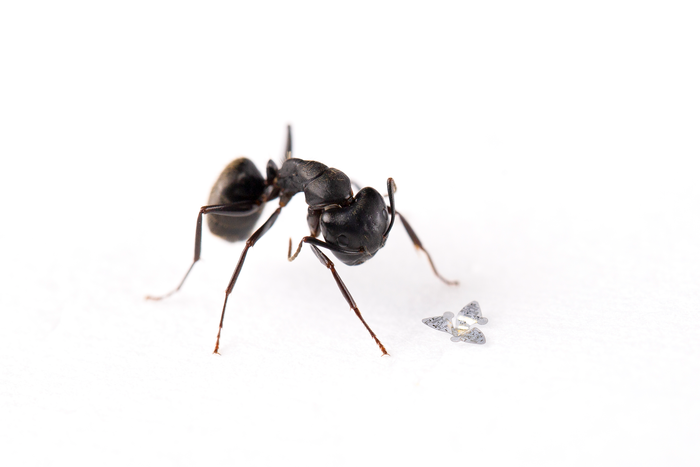
一只蚂蚁和史上最小飞行器的对比图。图片来源:Northwestern University
来源 Scientific American
原作 Nikk Ogasa
翻译 董聿恒
编辑 魏潇
每当春日将尽,槭树都会摇落一树带着翅膀的种子,让它们旋转着轻柔落向地面。这些像直升机一样的荚果,以及其它滑翔旋转的树种带给了工程师们空气动力学上的启发,他们宣布制造出了史上最小的风传送飞行器,称其为“microflier”。
这些飞行器中尺寸最大的型号(有时也被研究者称为“mesoflier” 或“macroflier” )全长约两毫米,大概和一只果蝇的体型相当。而最小的microflier则只有这个尺寸的四分之一。这让它们小到可以像树种一样随风飘扬,而又仍然足够大,可以负载装有传感器和无线传输装置的微芯片,收集周围环境的信息,并将这些数据发送给科学家们。正如美国西北大学(Northwestern University)的物理化学家 John Rogers 所说,我们可以将一大群 microflier 从空中投放下去,让它们借助风力布撒在一大片区域。“然后我们可以将它们开发成一套传感器网络,对这片区域进行环境污染、疾病扩散、生物危害等各种方面的测绘。”他补充道。Rogers 和他的同事撰写了一篇论文详细描述了这种飞行器。该论文 9 月 22 日发表在《自然》(Nature)上。
为了让他们的这些小玩意儿们能尽量稳定地下落,工程师们最开始参考分析了一些靠风力播种的植物种子的形状,例如大叶槭、羽叶槭和一些三星果属(Tristellateia)的藤本植物。随后,他们用计算机建模模拟与这些种子类似但又稍有不同的形状周围的空气流动。这个过程让研究者们能够精确地优化设计,直到这些 microflier 能够比它们的植物原型下落得更慢,更稳定。
为了监控广大的区域,Rogers 和他的同事需要制造非常大量的飞行器。如果能使用生产集成电路的流程和设备来制作,那么这个任务就简单多了。然而,这种制造工艺原本是用于生产平面形状的产品的,而 microflier 的结构是立体的。为了解决这个问题,工程师们先做出二维平面的 microflier,然后将它们贴在一层被称为“弹性体”的弹性材料上。当这层弹性体被松开后,它就会皱缩起来,将这些微型飞行器拉拽成所需要的立体形状。“通过这种方法,我们可以从平面形状出发,制作多种多样的立体有翼结构。” Rogers 如是说。
然而,除去这种飞行器给人带来的新奇感,它们实际上能对环境监测带来多少助益仍然是个未知数。这一观点来自没有参与该研究的环境流行病学家,加拿大麦吉尔大学(McGill University)的 Scott Weichenthal。“它们真的可以可靠地进行监测吗?”他质疑道,“把它们用在环境监测上,比起现有的技术到底有什么优势?这些问题都还没有答案。”
Rogers 声明,目前的 microflier 仍然只是对概念的验证。但是他和他的研究团队计划在不久的将来进行一次野外试验。他们计划空投上千枚飞行器,这些飞行器将会根据降落地点的铅、镉和水银的含量不同而变色。接下来,一架无人机会从降落区上空飞过,对地面拍摄高分辨率的航拍图片,定位这些变色的小飞行器,这样研究者们就可以对这片区域的污染物含量进行测绘了。
当然,将大量的这类微型机器布撒在大地上,看起来不是特别环保。为了防止破坏当地的生态环境,Rogers 和同事们使用对环境友好的聚合物材料、芯片和导线来制作 microfliers,它们都是可以缓慢自然降解的。在完成降落区域的数据收集和传输任务之后,这些微小的飞行器会解体并融化成黏糊糊的一团,最后被(环境中的)水冲刷掉。这不光对于环境更友好,也对研究者们更方便。正如 Rogers 所说:“我们可不想在工作完成之后还得把它们都捡回来。”
原文链接:
https://www.scientificamerican.com/article/winged-microchips-glide-like-tree-seeds/
本文来自微信公众号“科研圈”。
论文信息【标题】Three-dimensional electronic microfliers inspired by wind-dispersed seeds
【作者】Kim, B.H., Li, K., Kim, JT. et al.
【期刊】Nature
【日期】22 September 2021
【DOI】doi.org/10.1038/s41586-021-03847-y
【链接】
https://www.nature.com/articles/s41586-021-03847-y#citeas
【摘要】
Large, distributed collections of miniaturized, wireless electronic devices, may form the basis of future systems for environmental monitoring, population surveillance, disease management and other applications that demand coverage over expansive spatial scales. Aerial schemes to distribute the components for such networks are required, and—inspired by wind-dispersed seeds—we examined passive structures designed for controlled, unpowered flight across natural environments or city settings. Techniques in mechanically guided assembly of three-dimensional (3D) mesostructures provide access to miniature, 3D fliers optimized for such purposes, in processes that align with the most sophisticated production techniques for electronic, optoelectronic, microfluidic and microelectromechanical technologies. Here we demonstrate a range of 3D macro-, meso- and microscale fliers produced in this manner, including those that incorporate active electronic and colorimetric payloads. Analytical, computational and experimental studies of the aerodynamics of high-performance structures of this type establish a set of fundamental considerations in bio-inspired design, with a focus on 3D fliers that exhibit controlled rotational kinematics and low terminal velocities. An approach that represents these complex 3D structures as discrete numbers of blades captures the essential physics in simple, analytical scaling forms, validated by computational and experimental results. Battery-free, wireless devices and colorimetric sensors for environmental measurements provide simple examples of a wide spectrum of applications of these unusual concepts.梦境的本质是一种更加生动活泼、更加大胆放肆、更富创造力的思维方式

新闻来源:中科院半导体所,文中所述为作者独立观点,不代表icspec立场。更多精彩资讯请下载icspec App。如对本稿件有异议,请联系微信客服specltkj。
暂无评论哦,快来评论一下吧!
2026-07-01
2026-06-12

2026-07-11